
Teachers
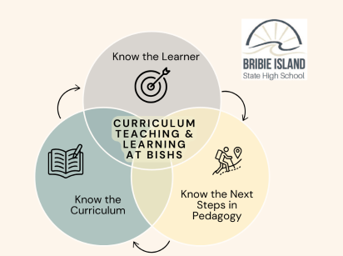
and Leaders at Bribie Island State High School believe that there are no limits
to learning. We are committed to understanding our learners, our curriculum and
what next steps we can take together to enhance learning experiences and
outcomes for our students. Staff are dedicated to creating a culture of
learning and a culture of belonging in every learning environment to ensure
that every student’s capacity for learning is maximised throughout their
schooling journey.
Culture of learning
Bribie Island State High School fosters a culture of learning by employing a whole school approach to pedagogy. Staff take the time to understand the individual and diverse needs of their students and employ a range of teaching and learning strategies to support student learning. Faculties determine the most effective pedagogies appropriate for their subject areas, which are evidence based and foregrounded in the Australian Curriculum Version 9 syllabus documents, and shape the way content is delivered, accessed, practised and reviewed across the school:
| The Arts | Humanities and Social Sciences | Health and Physical Education | Languages | Mathematics | Science | Technologies |
Inquiry-based learning - Reverse chronology - Experiential learning - Arts immersion approach | Inquiry-based learning - Experiential learning - Critical Inquiry | Strengths-based approach - Critical inquiry approach | Language in use approach - Intercultural language teaching and learning | Connectionist approach - Problem based learning - Inquiry based learning | Inquiry based learning - Transition model of learning | Systematic approach - Inquiry based learning - Project based learning - Problem based learning
|
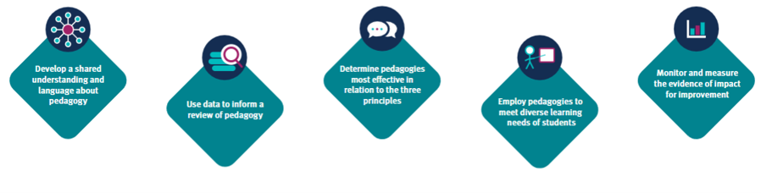
This whole school approach to pedagogy is a flexible, responsive and ongoing process that supports Bribie Island State High School to maximise student achievement, engagement and wellbeing of all students. This is a process which encourages leaders and teachers work together to:
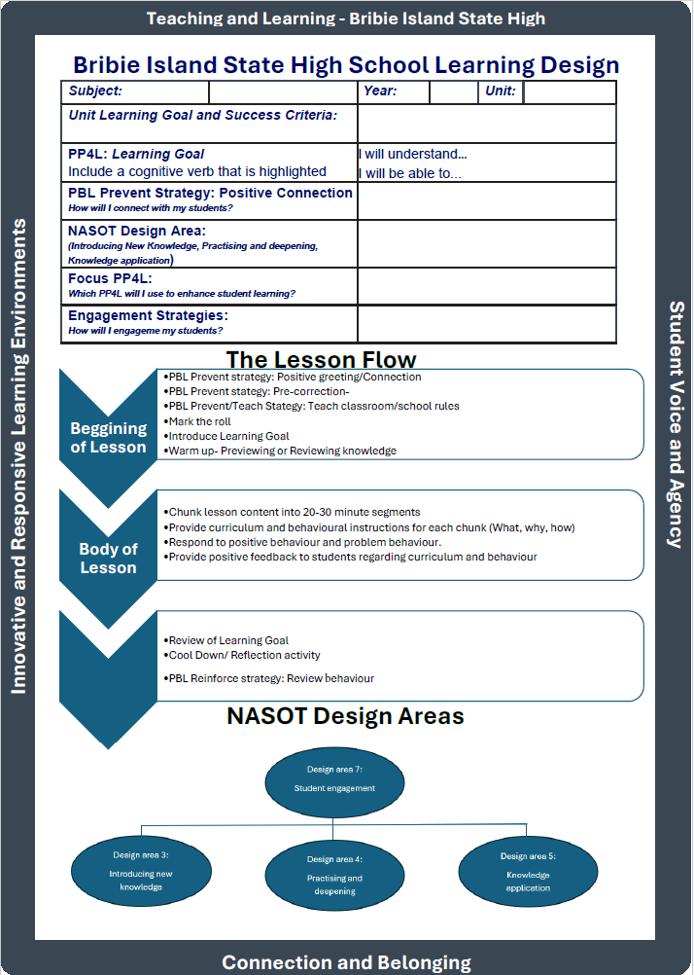
Every lesson, every day, staff utilise the Bribie Island State High School learning design which is drawn from Dr Marzarno's (2017) The New Art and Science of Teaching (NASOT). Establishing challenging and relevant learning goals that explicitly teach learning cognitions; delivering relevant warm-ups; modelling tasks and assessments; co-creating success criteria are non- negotiables at Bribie Island State High School and establish teaching and learning norms across the school. Additionally, Design areas 'introducing new knowledge'; 'practising and deepening'; and 'knowledge application' are used to plan effective learning experiences for students, and visible learning strategies are employed to assess student learning throughout these phases as well as reflection tasks. This in turn supports further differentiated planning within learning sequences and units.
Differentiating learning experiences and environments is our core business at Bribie Island State High School. We are aware that no two students are the same, and as such, all student differences are acknowledged, celebrated and supported in the classroom. Adjustments to access and participate in learning and assessment procedures stretch from quality differentiated teaching practice, supplementary adjustments, substantial and even extensive adjustments to support students and foster inclusive learning. Staff regularly engage in professional learning communities (PLCs) to share effective teaching and learning strategies for individuals, and students are case managed to further strengthen student access to the curriculum. These professional learning experiences are then directly implemented into our Learning Design to create personalised, rigorous and engaging learning episodes for students in each lesson.
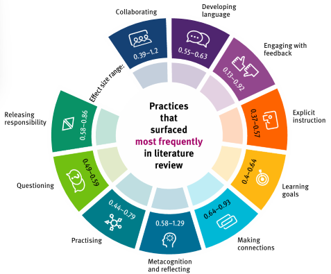
A cumulative effect of this extensive planning, delivering, supporting and reflecting on the needs of the curriculum, and learner, is that staff and leaders are in the perfect position to collaboratively identify the next steps in individual, group, and whole class learning. Evidence-based pedagogical practices for learning (PP4Ls) further inform teaching and learning exercises within each learning environment:
Teachers at Bribie Island State High School are dedicated professionals who value life- long learning. We engage in regular professional learning and constantly reflect, adjust and improve our practices to meet the everchanging landscape of education and our learners. As a direct result of this dynamic, purposeful, intentional and consistent enactment of curriculum and pedagogical practices, Bribie Island State High School ensures that student progress is at the forefront of our daily work, and that students are adequately supported and challenged throughout their schooling journey.